At the store
Choices, questions, checkout, and the small exchanges that make community life possible.
Communication support that grows with the person
KIN provides private, real-time communication support for persons with Autism and other neurodiverse adults—helping strengthen timing, clarity, relevance, and reciprocity while keeping every choice with the user.

“You could ask: how did you sleep?”
You decide what to use.Built for life as it happens
KIN is being built for ordinary conversations across home, work, relationships, errands, and community life—not only for practice sessions.
Choices, questions, checkout, and the small exchanges that make community life possible.
Everyday small talk, practical questions, shared stories, and familiar routines.
Meetings, task clarification, coworker check-ins, and professional collaboration.
Getting to know someone, handling pauses, and staying present without scripted performance.
Shared interests, humor, emotional disclosures, and meaningful back-and-forth.
Appointments, services, transportation, classes, and daily independent living.
Our mission
KIN does not speak for the user. It creates a private layer of support when a conversation becomes difficult: a pause runs long, an answer becomes tangled, a topic drifts, or a natural opportunity for reciprocity appears.
Support, not substitution. Guidance, not control.
Everyday life
KIN is being designed for the ordinary moments that shape independence, belonging, and opportunity.
The KIN experience
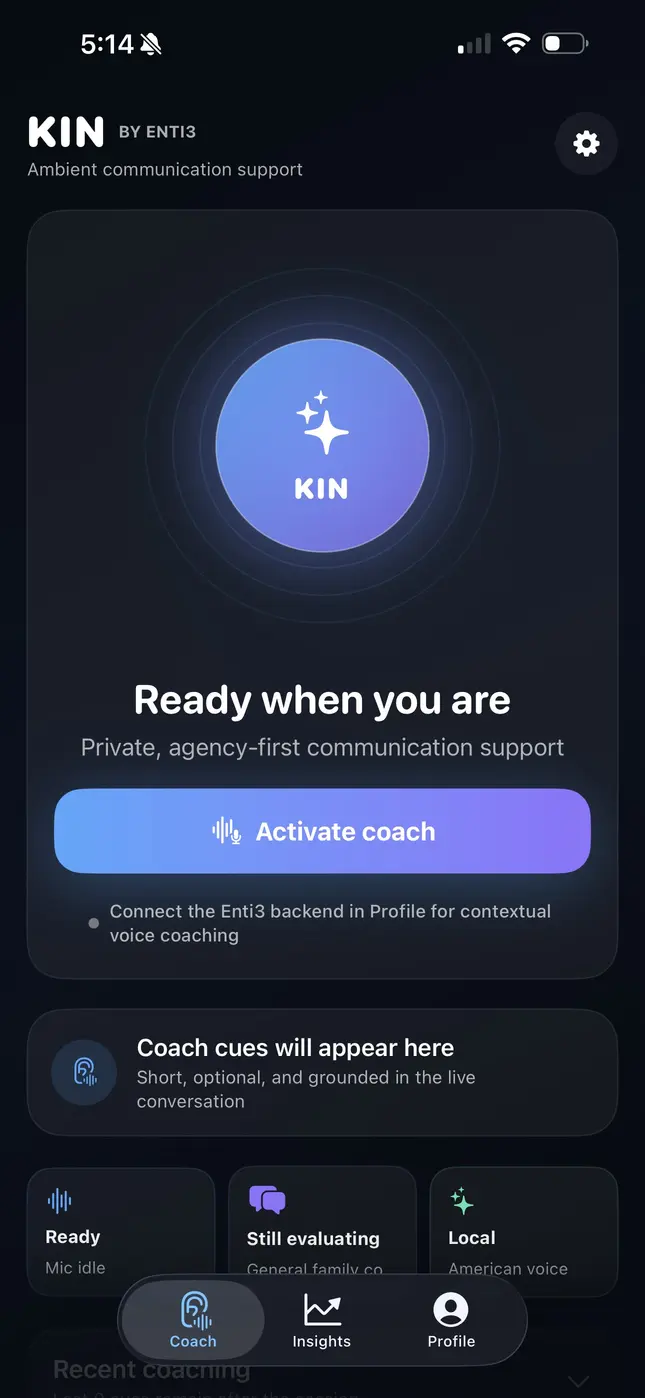
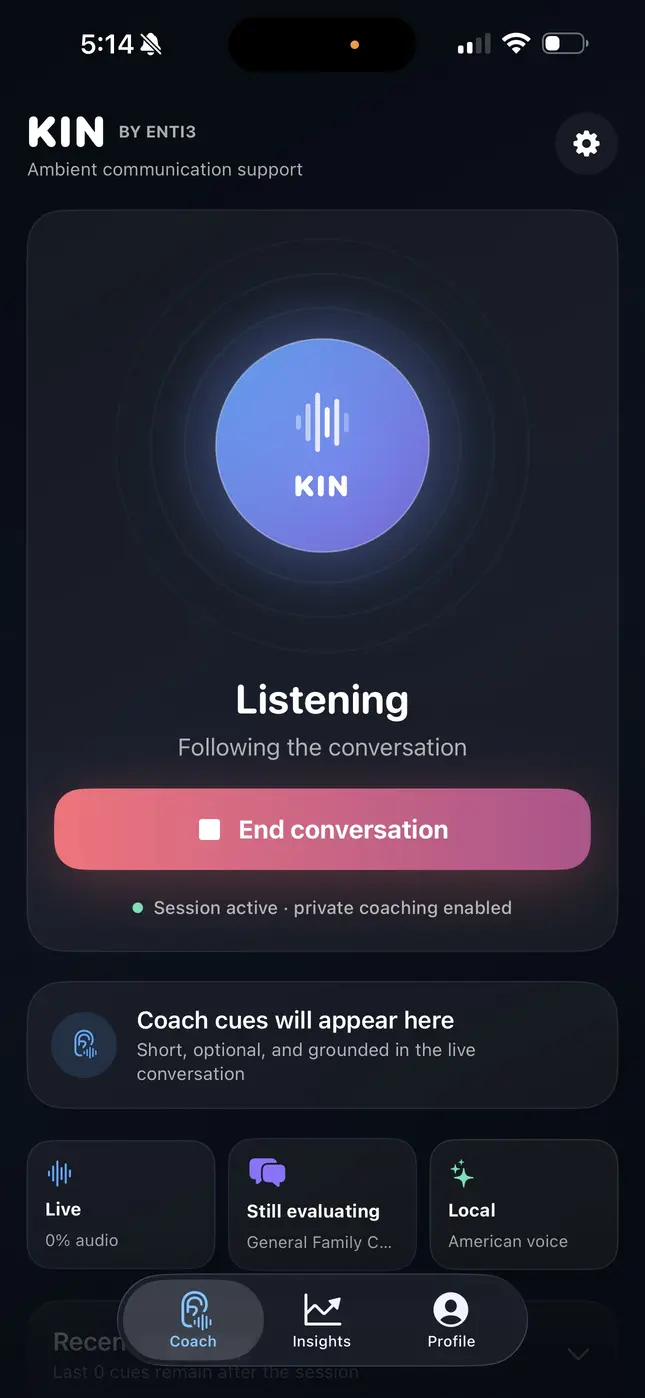
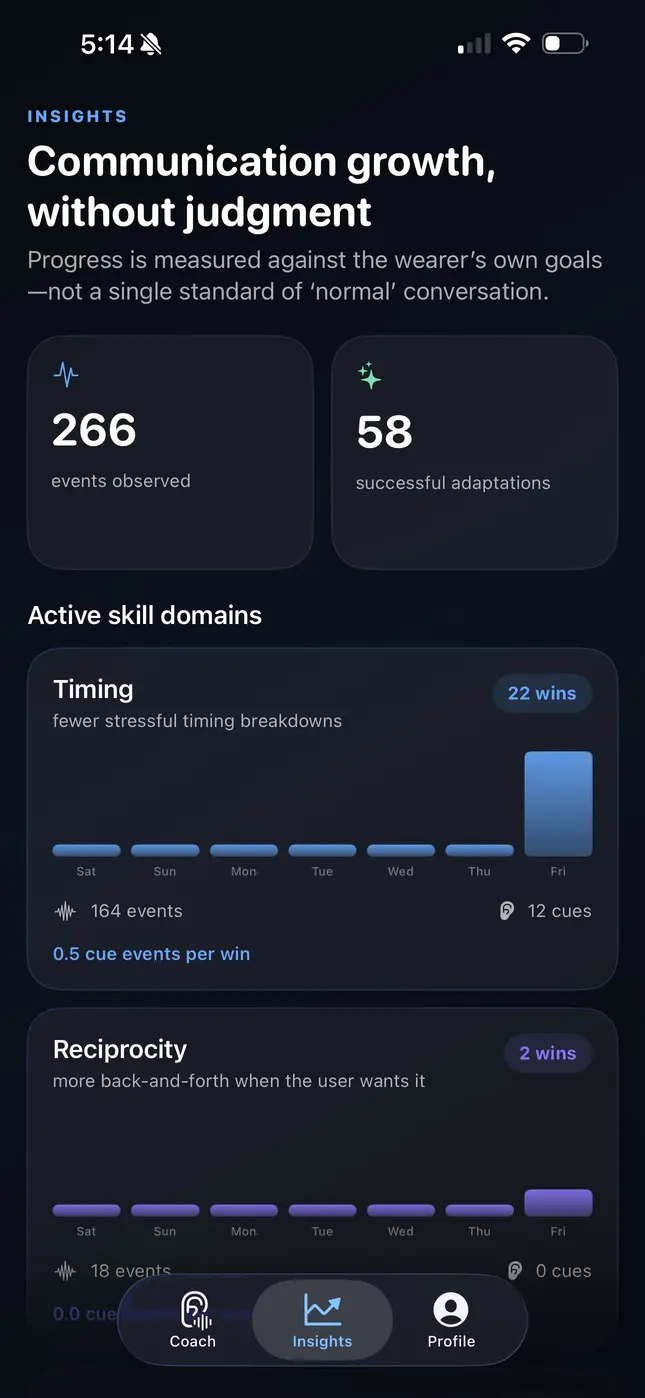
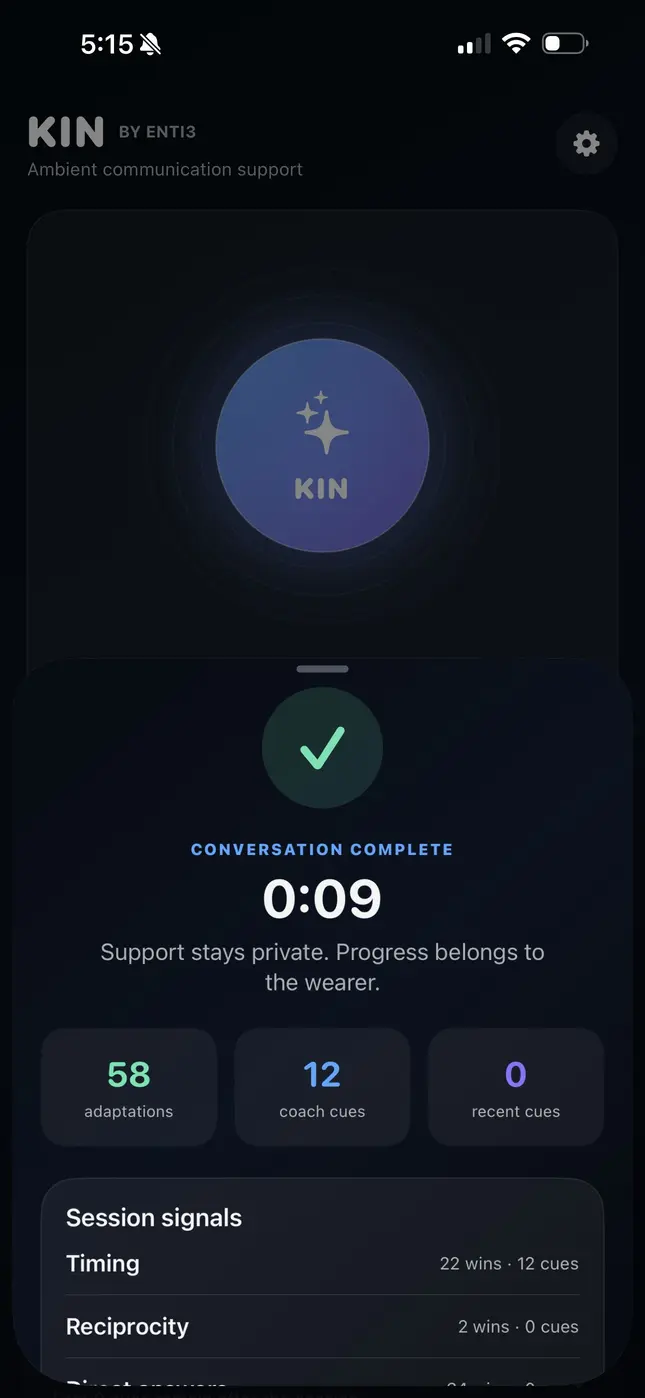
KIN begins when the wearer chooses. It listens only during an active session, offers optional support, and returns progress to the wearer—not to a scorecard of “normal” conversation.
How KIN works
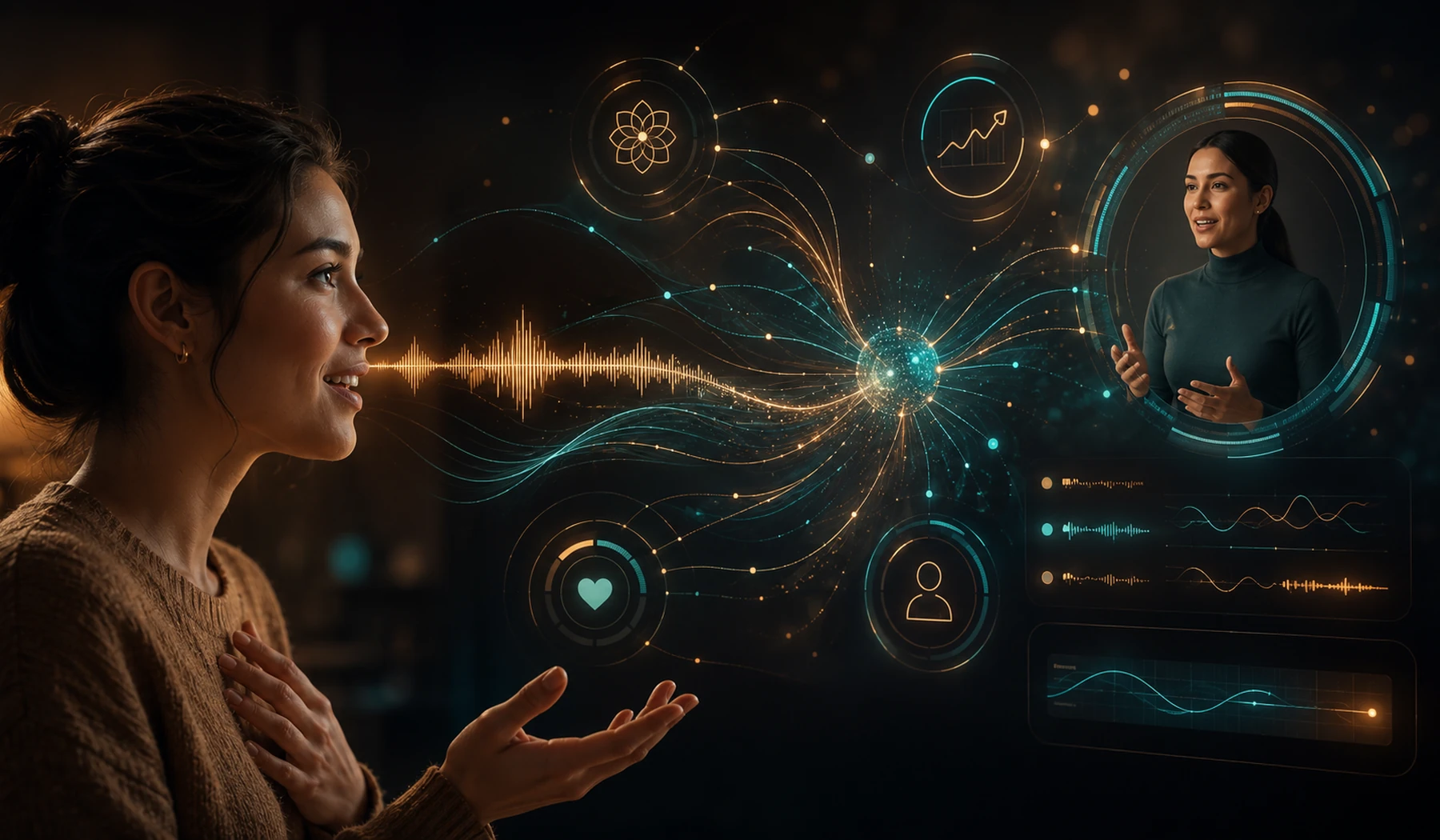
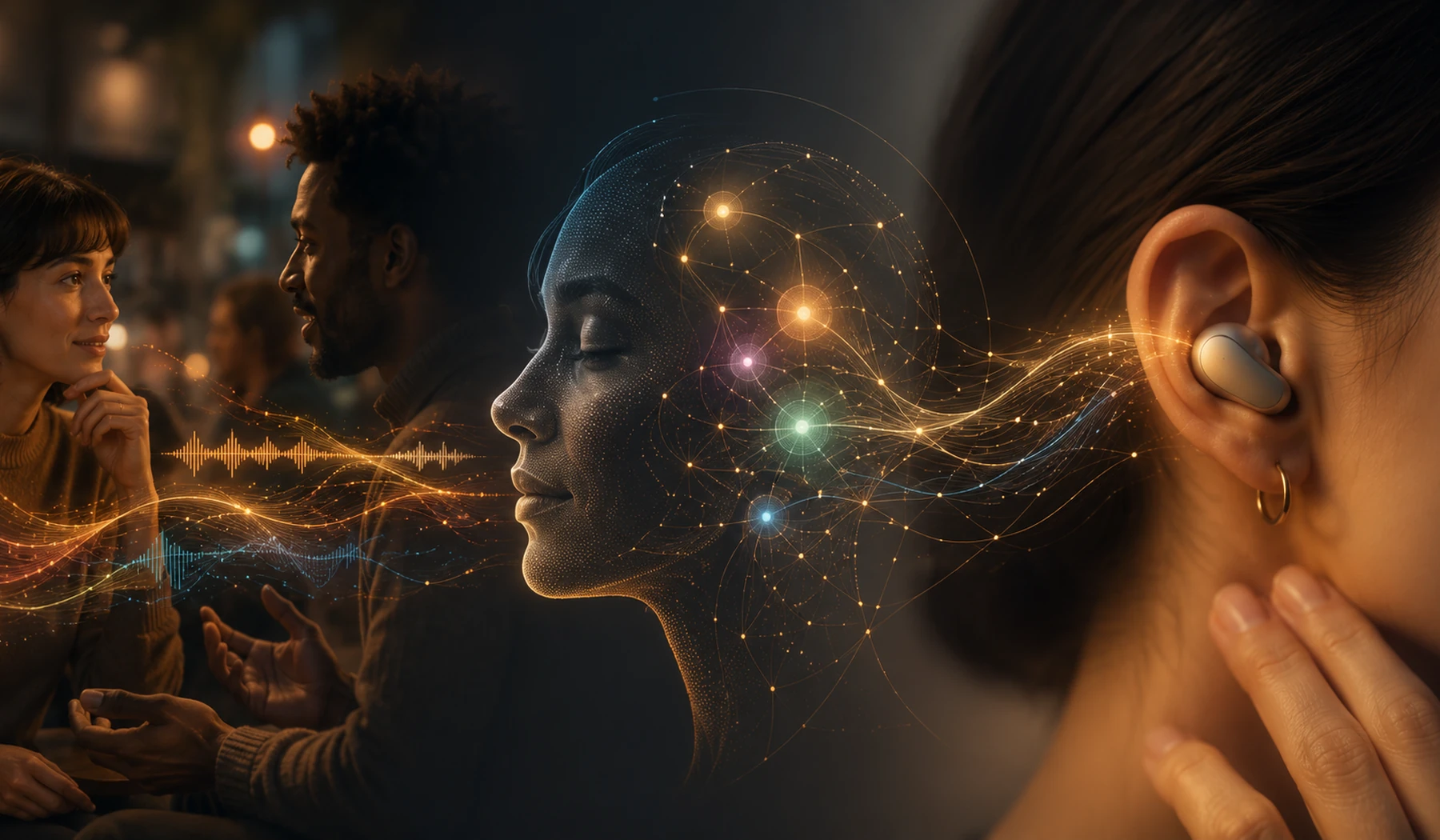
KIN combines natural-language processing, large language models, and a real-time conversation-state engine. The goal is not to force one “correct” style—it is to learn when, where, and how support is useful for this person.
A single press turns the current prototype on or off. The user decides when KIN is present.
KIN follows timing, turns, repetition, relevance, and the communicative request without retaining the raw conversation by default.
Natural-language processing and large language models help distinguish a direct question, a tangent, a completed answer, confusion, or a reciprocity opportunity.
With consented use and validated outcomes, KIN is designed to learn common expressions, pacing, preferred cue language, and the contexts where help is—or is not—useful.
A warm voice offers a brief example or action. The user can use it, change it, or ignore it.
Adaptation should be evidence-based, auditable, reversible, and guided by each person with Autism’s own experience.
Privacy by architecture
The current beta does not retain continuous raw audio or complete conversation transcripts by default. KIN stores only pseudonymous structured performance signals and generated cue text needed to evaluate reliability. Any future research recording requires separate, explicit consent.
Domains of communication KIN supports
Communication is not one skill. KIN considers several domains together before deciding whether support is useful.
Long pauses, run-on speech, speaking pace, turn entry, and turn completion.
Recognizing repeated words or ideas and helping organize the main point.
Helping answer the communicative request without unnecessary drift or delay.
Noticing tangents and offering a gentle path back to the current topic.
Providing language to ask for repetition, explanation, or more time.
Supporting acknowledgments, related follow-ups, and natural conversational back-and-forth.
Repair · topic initiation · topic maintenance · topic shifting · boundaries · emotional regulation · cue burden
KIN combines signals across domains. A four-second answer may be entirely appropriate; a three-second answer may already be repetitive or off-topic. Time begins an evaluation—it does not automatically trigger a correction.
A context-aware coach
Explore simplified examples of how the system thinks about different moments.
“A good example is: I’d like cereal.”Optional. Adaptable. Never spoken to the other person.
Human validation first
Human validation is a major focus of KIN. The software can surface a pattern, but each person with Autism’s experience determines whether that pattern was meaningful, whether the cue helped, and whether the system should adapt.
KIN detected a reciprocity opportunity after a family check-in.
Hardware built around the person
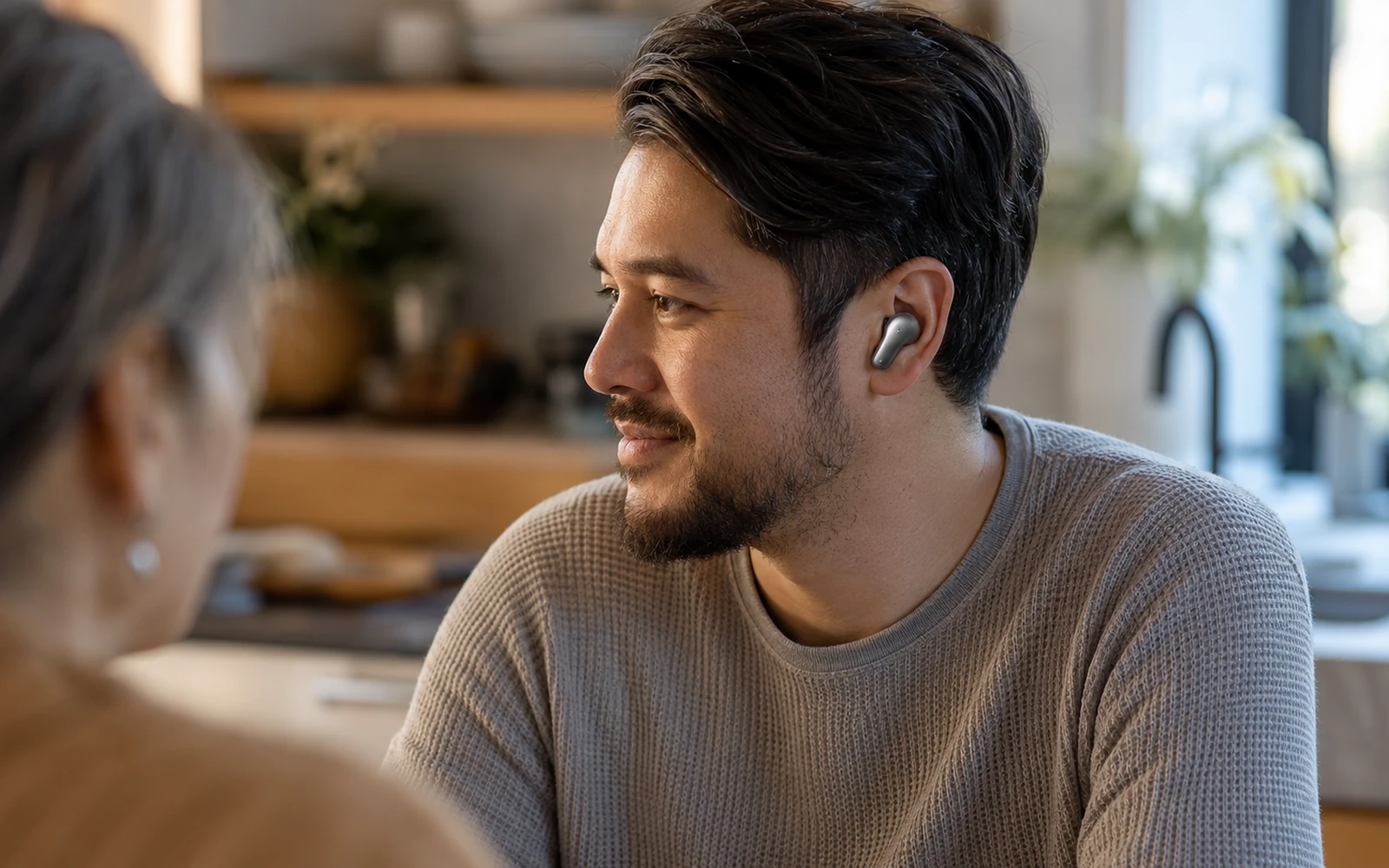
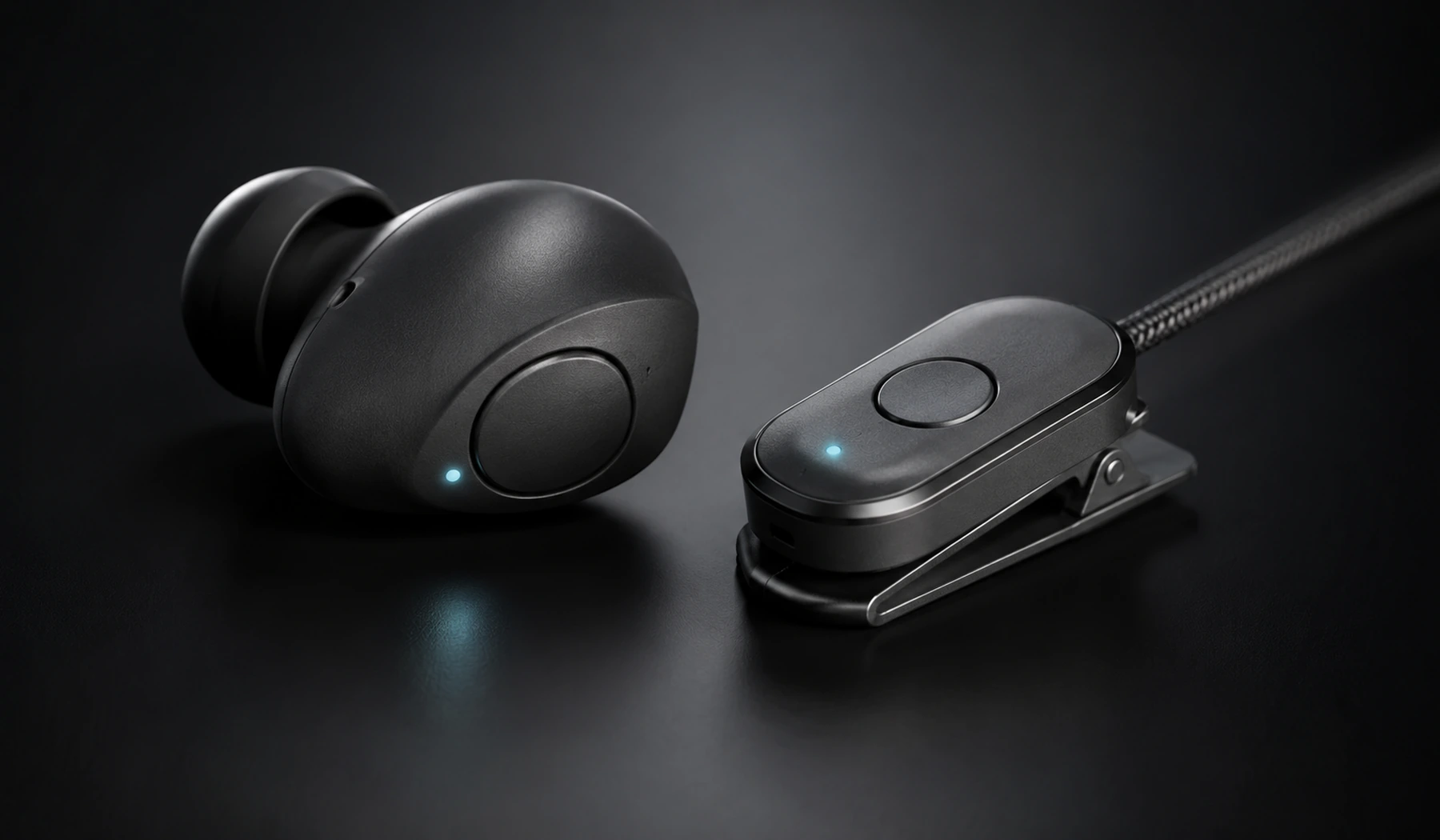
The first pilot intentionally uses hardware people can access now. The longer-term vision is a discreet KIN earpiece, lavalier-style clip, or coordinated system designed with persons with Autism—not merely for them.
Concept imagery. Final hardware design has not yet been manufactured.
Our story
KIN is the continuation of a career spent at the intersection of neurodiversity, human behavior, acute medicine, and technology.
Before medical training, Christopher Taicher worked in behavioral therapy supporting persons with Autism—years before becoming a physician or technology founder.
He became an emergency medicine physician and completed the Harvard-affiliated residency at Massachusetts General Hospital and Brigham and Women’s Hospital.
Before modern language models made real-time coaching practical, he designed Enti3’s original natural-language-processing architecture for contextual communication support.
KIN combines live conversation signals, NLP, LLMs, private audio, structured outcomes, and human validation to support more self-determined communication.
The concept drew institutional and media attention while the enabling technology was still emerging.
 PROCOPIO
Enti3 was chosen for Procopio’s LaunchPad incubator, where emerging companies receive corporate, intellectual-property, and growth support.
Read the LaunchPad announcement ↗The work and its founder were recognized in the publication’s 2022 Technology Achievement coverage.
View San Diego Business Journal coverage ↗Help shape what comes next
We are looking for persons with Autism and other neurodiverse adults—and a family member willing to have ordinary conversations—to help us understand what is useful, mistimed, distracting, or genuinely empowering.
Questions
No. KIN offers one private option. The user chooses whether to use it, change it, or ignore it.
No. KIN is an experimental communication-support prototype and is not an emergency, diagnostic, or treatment service.
No. Continuous raw audio and complete conversation transcripts are not retained by default. The beta may store pseudonymous structured performance events and generated cue text so the team can evaluate reliability and improvement.
They are inexpensive, private, do not need charging, and provide a physical cord button that can give the user direct control over when support is active.
With consented use, KIN is designed to learn the person’s common expressions, pacing, preferred wording, and the contexts where support is useful—or unnecessary. Adaptations should remain bounded, auditable, reversible, and human-validated.
KIN by Enti3
Help us build communication support that learns the person without replacing their voice.